Purpose: The DLA Energy's Aerospace Fuels Supplier Pathway outlines the steps for an Aerospace Supplier can take to work with DLA Energy.
Objectives:
- Provide instructions on how Aerospace Suppliers can do business with DLA Energy
- Give an overview of how Suppliers can conduct market research
- Provide step-by-step guidance on submitting proposals to DLA Energy Aerospace
Revised: 01/20/26
This is a general overview process, the solicitation will always take precedence. Solicitations are written on a case-by-case basis because of specific requirements provided by the customer to DLA (most often, the Military Services).
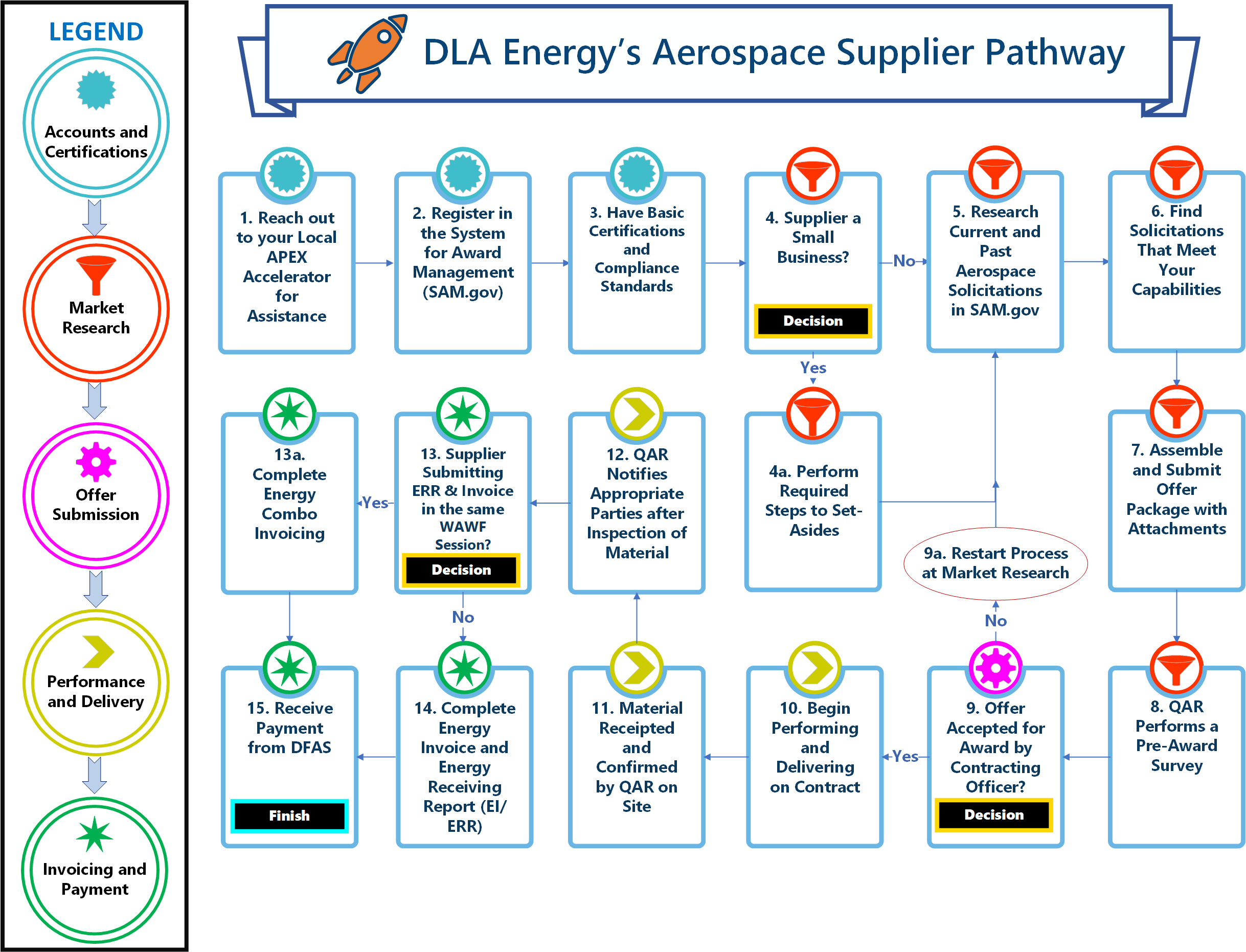
Navigate:
Introduction to DLA Energy Aerospace
- Reach Out to Your Local APEX Accelerators for Assistance
- Register in the System for Award Management (SAM.gov)
- Obtain Basic Certifications and Meet Compliance Standards
- Is the Supplier a Small Business?
- Complete Required Steps to Accept Set-Asides for Business
- Research Current and Past Aerospace Solicitations in SAM.gov
- Find Solicitations That Meet Your Capabilities
- Assemble and Submit Offer Package with Attachments
- Quality Assurance Representative (QAR) Performs a Pre-Award Survey
- Is the Offer Accepted for Award by the Contracting Officer?
- Restart Process at Market Research
- Begin Performing and Delivering on Contract
- Material Receipted and Confirmed by QAR on Site
- QAR Notifies Appropriate Parties After Inspection of Material
- Is the Supplier Submitting the ERR & Invoice in the same WAWF Session?
- Complete Energy Combo Invoicing
- Complete Energy Invoice and Energy Receiving Report (EI/ERR)
- Receive Payment from DFAS
Resources and Terms Glossary
DLA Energy Aerospace Program
DLA Energy Aerospace is the Supply Chain Manager for 92 National Stock Numbers (NSN), supplying specialty fuels and related products and services for advanced weapon systems, space applications, and other programs to the Department of War (DoW), Federal agencies, and private industry.
Aerospace Energy also manages the worldwide acquisition of missile fuels, liquid propellants for space launch and satellites, aviator’s breathing oxygen, and other bulk industrial chemicals and gases.
The Aerospace business, as the DoW Integrated Materiel Manager, manages products such as:
Propellants:
- Hypergolic
- Hydrazine Fuels (6 grades)
- Dinitrogen Tetroxide (5 grades)
- Inhibited Red Fuming Nitric Acid
- Non-hypergolic
- Rocket Propellant (Grades 1 & 2)
- JP10 (Gas Turbine Fuel for Missiles)
- Priming Fluid
- Methanol
- Hydrogen Peroxide
- Isopropyl Alcohol
- Cryogenic
- Liquid Oxygen
- Liquid Hydrogen
Non-Propellant Cryogens
- Aviator’s Breathing Oxygen
- Liquid Nitrogen
- Liquid Argon
- Liquid Helium
- Liquid Carbon Dioxide
Compressed Gases
- Helium
- Nitrogen
- Argon
- Hydrogen
- Deuterium
- Nitrogen Trifluoride
- Fluorine
- Xenon
- Krypton Neon
APEX Accelerators, formerly known as Procurement Technical Assistance Programs, assist businesses in pursuit of Federal Government contracts by providing education and training to ensure that all businesses become capable of participating in federal, state, and local Government contracts, including DLA. Some education and training topics include:
- How to register and use DoW/DLA applications, like the System for Award Management (SAM.gov), which is required to acquire a Commercial and Government Entity (CAGE) Code
- Help small businesses navigate solicitations and potential funding opportunities
The System for Award Management (previously known as Central Contract Registration) is a database that requires registration when submitting an offer or quotation in response to a solicitation for a Federal Government contract, basic agreement, basic ordering agreement, or blanket purchase agreement.
During the entity validation step when registering in SAM.gov, Suppliers will be assigned a Commercial and Government Entity (CAGE) Code, which is needed to do business with the DoW and DLA.
Registration in SAM.gov is free.
In order to become an Aerospace Supplier for DLA, certain basic certifications and adherence to compliance standards is required.
Certifications
Compliance
The above are general certifications and regulations that must be met.
However, for the full listing of all certifications that are needed and all regulations that must be followed, review all Solicitation sections.
For more information, see Understanding a Solicitation Using Uniform Contract Format.
Back to Top
In order for a Supplier to be considered an eligible small business for set-asides or other small business program considerations, they must have the NAICS classification 325120 - Industrial Gas Manufacturing.
If the solicitation states Small Business status will be taken into account, determine if Small Business requirements are met:
The typical Small Business Socio-Economic considerations that may be available (for domestic procurement only):
- 8(a) Reservations
- HUBZone Premium Program
- Small Business Set-Asides (price matching)
Set-Asides
Small Business set-asides are determined at each location based on the expected level of small business competition because it is difficult for Small Businesses to manufacture the specialized products Aerospace needs in the fuels industry, as plants are expensive to operate.
Note: If the Nonmanufacturer Rule is incorporated into the solicitation, a Small Business that is a nonmanufacturer must receive its product from a Small Business manufacturer to be considered eligible for set-asides.
Determine if the solicitation states "Small Business Set-Aside" is available. The solicitation will directly state whether set-asides will be available for small businesses or not.
Example of a solicitation having Small Business set-aside opportunities.
Important: If an overseas procurement is involved, small business set-asides will not be available.
Example of a solicitation not having Small Business set-aside opportunities.
DLA Energy Aerospace rarely uses Small Business set-asides, but when they are implemented, they are similar to the rest of Government procurement practices. Namely, if two or more valid, capable, responsible Small Businesses have demonstrated interest, the competition is set aside for only Small Businesses to offer.
This is unlike how DLA Energy Bulk Petroleum evaluates set-aside awards as they use a price matching strategy with eligible Small Businesses. For more information, see Step 13 on Bulk Petroleum Set-Asides.
In these procurements, like the predominance of the DLA Energy Aerospace work, the Lowest Price Technically Acceptable (LPTA) source selection procedures are typically used.
For more information on the LPTA process, see step 9.
Suppliers should review current and previous solicitations in SAM.gov in order to understand the needs of DLA Energy Aerospace.
To find Aerospace solicitations, search in SAM.gov's Contracting using the DoD Activity Address Code (DoDAAC) SPE601.
After looking at active listings, switch to inactive or archived listings of solicitations to see what offers and bids succeeded in the past:
Under the Status section located in the Filter By section, select the checkbox for Inactive and de-select the checkbox for Active to see old solicitations.
Begin reviewing Notice Types labeled Solicitation or Updated Solicitation.
Tip: Remember to focus on Notice Type "Solicitation" or "Updated Solicitation" for the most relevant information while conducting market research.
Review solicitations present in listings on SAM.gov. There are typically four phases to a solicitation for Aerospace:
- Sources Sought - Used to gather basic information on availability and interest for Suppliers to meet the demands of a potential future solicitation, customer need, or business need. Usually gives basic information on:
- Specification requirements for needed items
- Location
- Anticipated period of performance
- Estimated quantities
- Instructions for Suppliers on how to submit their capability statements if interested
- Pre-solicitation/Synopsis (usually a Request For Information or RFI) - Used to provide Suppliers an opportunity to gain a better understanding of the requirement and submit their capability statements
- Solicitation - Standard solicitation to make official bids
- Original Award Notice - SAM.gov notice stating the successful Offeror and the contract price under the award
Note: As time progresses, the above documents can be amended (updated) to reflect recent changes, such as requirement updates or additional clarifications needed within the documents themselves.
For more information on SAM.gov Solicitation Notice Types see: What are the notice types for Contract Opportunities in SAM.gov?
See the example below of different Notice Types:
Suppliers can also use the advanced search filter on SAM.gov to save searches and then receive notifications by email every time a new solicitation is released with the saved criteria.
Suppliers need to review the solicitation and ensure they have the capabilities to fulfill, if awarded, all requirement sections/topics and Statement of Objectives (SOO), including the ability to meet (not all-inclusive):
- Supply demand schedule
- Supply demand quantity
- Location, packaging, and delivery requirements
- Technical and Quality Standards in Quality Assurance Provisions (QAPs)
- Military and Commercial standards stated (e.g., MIL-PRF-27210J for MILSPEC Oxygen Aviator Breathing)
Solicitations will state the specifications that the product being procured must meet. Most commonly they are MIL and ASTM standards; however, Commercial standards may be stated and required.
Some of the standards may be directly stated in the solicitation on SAM.gov; however, they will always be stated in the QAPs which will be attached in the Attachments section of the solicitation.
Sometimes the QAPs are attached within the solicitation document.
Examples of Quality Assurance Provisions:
Suppliers should always thoroughly review the entire solicitation, especially, but not limited to:
- Section B - Schedule of Supplies and Services within the continuation pages of the solicitation
- Any separate Requirements Pages attached to the solicitation
Example of separate Requirements Page:
In addition to standards, instructions for points of inspection will be outlined. Become familiar with what is stated to prepare for your product's point of inspection.
Every procurement has unique document requirements. While this section lists common examples, Suppliers must review the solicitation carefully and submit all necessary documents with their proposal.
The Offeror will assemble the following completed documents into an Offer Package that is complete, signed, and returned to the Contracting Officer (i.e., Point of Contact) listed at the bottom of the solicitation in the SAM.gov notice:
- Complete the solicitation-specific offer documents (all or some may be required, review solicitation):
- Pricing Proposal Worksheet - Pricing worksheet with Supplier's offered prices that needs to be completed for each Contract Line Item Number (CLIN), unless the Schedule notes that multiple awards will be made. In such cases, the Offeror may select specific CLINs or groups of CLINs (e.g., those applying to a particular customer location) against which to submit an offer. See example below:
- Vendor Technical Proposal - The Technical proposal is only required if specified by the solicitation. The proposal is the way a Supplier proves their technical capability to the Government. The Offeror may submit continuation sheets with this fill-in provision to provide additional technical narrative; however, the complete technical proposal, exclusive of any résumés, drawings, or blueprints, may have maximum page limit submissions. Be sure to double check the solicitation for page limit restrictions.
The proposal will be evaluated strictly on technical merit and should describe and justify the Offeror's technical approach to the requirements of the work to be performed and/or delivery of product under the contract. The technical proposal should be specific and provide concise, straight-forward descriptions of the Offeror's capability to perform the requirements of the contract. Proposals that are unrealistic in terms of the description of the Offeror’s technical capability may be considered indicative of a lack of understanding of the solicitation’s requirements.
General description of how the Offeror will ensure a reliable supply of on-spec product and/or service to meet the Government’s requirements will be stated in the solicitation, including, but not limited to:
- Production capability per day of proposed fill plant.
- Plant storage capacity for product offered.
- If the Offeror will be making deliveries to customers, describe type, number, and size of containers that will be used for delivery of product to each customer location that the Offeror proposes on.
- If the contract requires maintenance and repair of Government Owned Equipment, such as repairs to cylinders or tube trailers, describe how such services will be performed to meet solicitation requirements.
- Describe the in-process quality control procedures that will ensure the production and delivery of on-spec product.
- Describe Offeror’s proposed quality sampling plan that will be implemented to assure individual shipments made under this solicitation meet the product quality requirements stated in the applicable specification or product description.
- Describe all Contractor provided equipment to include a description of size, certifications, instrumentation (including alarms), design parameters, etc.
- Include a timeline for the purchase, installation, testing, and commissioning of the equipment.
- Describe the method for securing delivery container(s) and/or cargo tank openings with tamper-indicating devices (i.e., seals) to prevent tampering and/or pilferage from the time the cargo tank is loaded until it is delivered to its destination.
- For solicitations containing product CLINs, if the Offeror is not the manufacturer of the product to be delivered under the contract or is otherwise proposing to provide product from a fill plant or production facility other than one owned and operated by the Offeror, the Offeror shall provide a written supply commitment letter from the owner of the fill plant or production facility from where the product will be obtained in performance of any resultant contract. The written supply commitment shall clearly indicate:
If the owner of the fill plant or production facility is willing to provide the products and/or services required to be delivered/performed under any resultant contract for the duration of the delivery period shown in the Schedule, and there is confirmation of the quantity and specification of the products to be delivered, then the following may be requested as well in the Technical Proposal:
- Product(s) to be supplied shall fully meet the requirements of the applicable specification(s) as stated in the Statement of Objectives (SOO), unless otherwise modified elsewhere in this solicitation and/or the resultant contract.
- General description of how the Offeror will ensure a reliable supply of on-spec product/service to meet the Government’s requirements.
- Quality Control Plan for review.
- These fields/sections of the Solicitation/Contract/Order for Commercial Products and Commercial Services Standard Form SF1449 must be completed:
- Vendor pricing information (unit and total price without taxes that the Government is exempt from)
- CAGE Code in Block 17a of the Standard Form 1449, in the box labeled “CAGE CODE”
- Manufacturing, filling points, transport truck, and/or truck and trailer free time and detention rates (Aerospace Energy contract provisions)
- If needed, add all certifications and representations requested in Section K of the solicitation
- Contractor Performance Data Sheet - The Supplier must fill this out as a reference sheet of past Government and non-Government contracts and subcontracts to validate their history of performance with DLA.
- Transport Equipment Delay Certification - Filled out only if the Supplier is expecting delays in shipment/transportation
- Certificate of Analysis - Quality assurance document ensuring product(s) being supplied meet required standards.
- Energy Quality Assurance Provisions - Energy quality assurance standards that, if indicated in solicitation, need to be met.
- Additional Attachments - Typically attachments needed for justifications.
A Supplier can withdraw a previously submitted offer from consideration.
Important: Check often while the solicitation is open for amendments (updates) made to the live solicitation. To acknowledge amendments, complete Blocks 15A, 15B, and 15C of the Standard Forms (SF) 30 and return to DLA Energy by emailing the Contracting Officer Point of Contact (POC) listed in the solicitation.
The Contracting Officer may request that a DLA Energy Quality Assurance Representative (QAR) perform a Pre-Award Survey (PAS) in accordance with FAR Part 9.106-1 to ensure that the capabilities exist to support the requirement the Offeror bid against, mitigating risk of non-performance due to lack of capability, and may include an on-site review.
After the PAS results are announced, guidance on the next steps will be provided by the KO.
If requested, the Offeror and its employees, including those at the fill point and/or production facility, shall be required to participate fully in the PAS process.
The DLA Energy Contracting Officer will discuss any PAS results recommended by the QAR that are other than "Recommend Full Award."
The Offeror is encouraged to submit their best and final offer. The Government reserves the right to award or not award without discussion or negotiation.
After the submission deadline, the evaluation team, including the Contracting Officer (KO), evaluates all offers in accordance with the solicitation to determine the best value for the Government.
Typically, the Lowest Price Technically Acceptable (LPTA) (in accordance with FAR 15.101-2) is used in DLA Energy Aerospace evaluations. In an LPTA evaluation, the award is made to the Offeror who submits the lowest-priced offer that meets the minimum technical requirements defined in the solicitation, deemed as Technically Acceptable.
If any part of the solicitation is unclear, it is strongly encouraged to ask for clarification. Submit all questions or recommended changes to the Contracting Officer within 10 calendar days of the solicitation's issuance.
Proposals that take exception to the solicitation's mandatory requirements may be deemed unacceptable and removed from consideration. If your proposed exception requires a change to the solicitation, it could lead to the Government amending the solicitation, which may cause delays in the award process.
For help understanding Government solicitations, see Understanding Contract Basics.
If an offer is not accepted, a Supplier can restart the process and begin researching DLA Aerospace opportunities using step 5 - Search Solicitations.
Back to Top
When a Supplier is awarded a contract, a notification will be sent to their email that was specified in the offer package.
Once the order is received, begin to perform on the contract adhering to all:
- Standards
- Contract delivery methods
- Contract delivery schedules
- Contract quantity
- Any other details mentioned in the SF1449
Who to Contact for Questions During Performance Period?
For contract-related questions and requests, reach out to the Contract Administrator assigned to your contract. Most often, it is the same POC as stated in the solicitation.
Quality Assurance Representative (QAR) ensures material was delivered in accordance with Quality Assurance Provisions (QAPs) outlined in the solicitation and contract as discussed in Step 6 - Find Solicitations that Meet Your Capabilities.
Examples may include:
- If delivered by truck with tank, ensure the truck is properly clean and free from residue and contaminants from other loads of different materials.
- If by pipeline, the quality check will occur at the Origin Inspection.
Quality Assurance Representative (QAR) will notify all appropriate parties after inspection of material, whether by pipeline, barge, tanker, etc.
If the quality inspection passes, the Acceptor will receive and process material.
If the quality inspection fails, the material is rejected onsite and Supplier will need to get with their Contract Administrator for resolution.
In order to submit an invoice that DFAS can pay, the Supplier must submit the Invoice and Energy Receiving Report (ERR) into WAWF.
To submit an invoice, a user will need to have access to the Procurement Integrated Enterprise Environment (PIEE) in order to have access to Wide Area Workflow (WAWF), which is used to submit invoices to DLA and then routes the information to the Defense Finance and Accounting Service (DFAS) for processing for payment.
There are two slightly different invoicing processes depending on whether the Supplier already has an ERR in hand. Suppliers have different business practices based upon their priorities.
Combo Invoicing
If an ERR was not created during delivery, the Supplier will need to do an Energy Combo Invoice. With an Energy Combo Invoice, the Supplier enters information into WAWF and WAWF will generate both the Invoice and the ERR.
Energy Invoice / Energy Receiving Report
If an ERR was created by the acceptor of the material or by the Supplier, then the Supplier will need to enter data separately for the Energy Invoice and re-enter it again for the Energy Receiving Report.
When creating a Combo Invoicing Process, both the Invoice and Receiving Report will be generated at the same time. Review the following guides:
Important: If a WAWF user attempts to create an ECOMBO with an Inspector or Acceptor DoDAAC which has no active users registered against it, the user will receive a pop-up message stating no active users are registered against the entered DoDAAC and advising them to submit a stand-alone Invoice (i.e., the EI and ERR).
The Supplier will need to perform two rounds of data entry into WAWF: the first to enter data to create an Energy Receiving Report, and the second to enter information to create an Invoice.
See the following WAWF guides to create separately, the EI and ERR:
Once the invoice (typically with receiving report) has been submitted in WAWF, it will be routed to the Defense Finance and Accounting Service (DFAS) for processing.
Typically, payment terms are 30 days, but this will be stated in the contract. DFAS evaluates the submitted Invoice and ERR by using a "3-Way Match" that seeks matching information across the Contract, Invoice, and ERR and then pre-validates the invoice. After approval, the DFAS Disbursing Office will send a check or Electronic Funds Transfer (EFT) to the Supplier and update myInvoice.
To check invoice payment status, a Supplier can check myInvoice in WAWF or see if a Payment Official has done any action to the WAWF-submitted invoice.
MyInvoice is a web-based application developed specifically for Suppliers and Government users to obtain the status of their invoices.
See the following DFAS video below to see how to check payment status in myInvoice.
Check for Payment Official Action
Another way to check the status of your invoice in WAWF is to follow these steps:
- Log in to WAWF and select the Vendor tab.
- From the dropdown, select the History folder.
- Use the search fields to locate the Combo Invoice.
- Click Submit.
- Locate the invoice heading and then click on the linked document below.
- Your invoice will open, scroll down to the bottom of the page, and under Action By: Payment Official you can view the status of your invoice.
Resources:
Terms Glossary
Find meanings for acronyms, abbreviations, and codes used throughout the process article below in the table:
| Term Used |
Meaning/Definition |
| ASTM |
American Society for Testing and Materials |
| CAGE |
Commercial and Government Entity |
| CLIN |
Contract Line Item Number |
| CMMC |
Cybersecurity Maturity Model Certification |
| DFARS |
Defense Federal Acquisition Regulation Supplement |
| DFAS |
Defense Finance and Accounting Services |
| DIBBS |
DLA Internet Bid Board System |
| DoW |
Department of War (formerly Department of Defense) |
| DoDAAC |
Department of Defense Activity Address Code |
| EFT |
Electronic Funds Transfer |
| ECombo |
Energy Combo |
| EI |
Energy Invoice |
| ERR |
Energy Receiving Report |
| FAR |
Federal Acquisition Regulation |
| MILSPEC |
Military Specification |
| NSN |
National Stock Number |
| PAS |
Pre-Award Survey |
| OSBP |
Office of Small Business Programs |
| PIEE |
Procurement Integrated Enterprise Environment |
| PQDR |
Product Quality Deficiency Report |
| QAPs |
Quality Assurance Provisions |
| QAR |
Quality Assurance Representative |
| RFI |
Request for Information |
| SAM.gov |
System for Award Management |
| SF1449 |
Solicitation/Contract/Order for Commercial Products and Commercial Services |
| SOO |
Statement of Objectives |
| TAA |
Trade Agreement Act |
| WAWF |
Wide Area Workflow |